
Main Sewer Line Cleaning in Kyle, TX
When the whole house stops draining at once, the problem has left the walls and is out in the lateral — the single pipe that carries everything from your house to the city sewer.
Call (737) 385-7666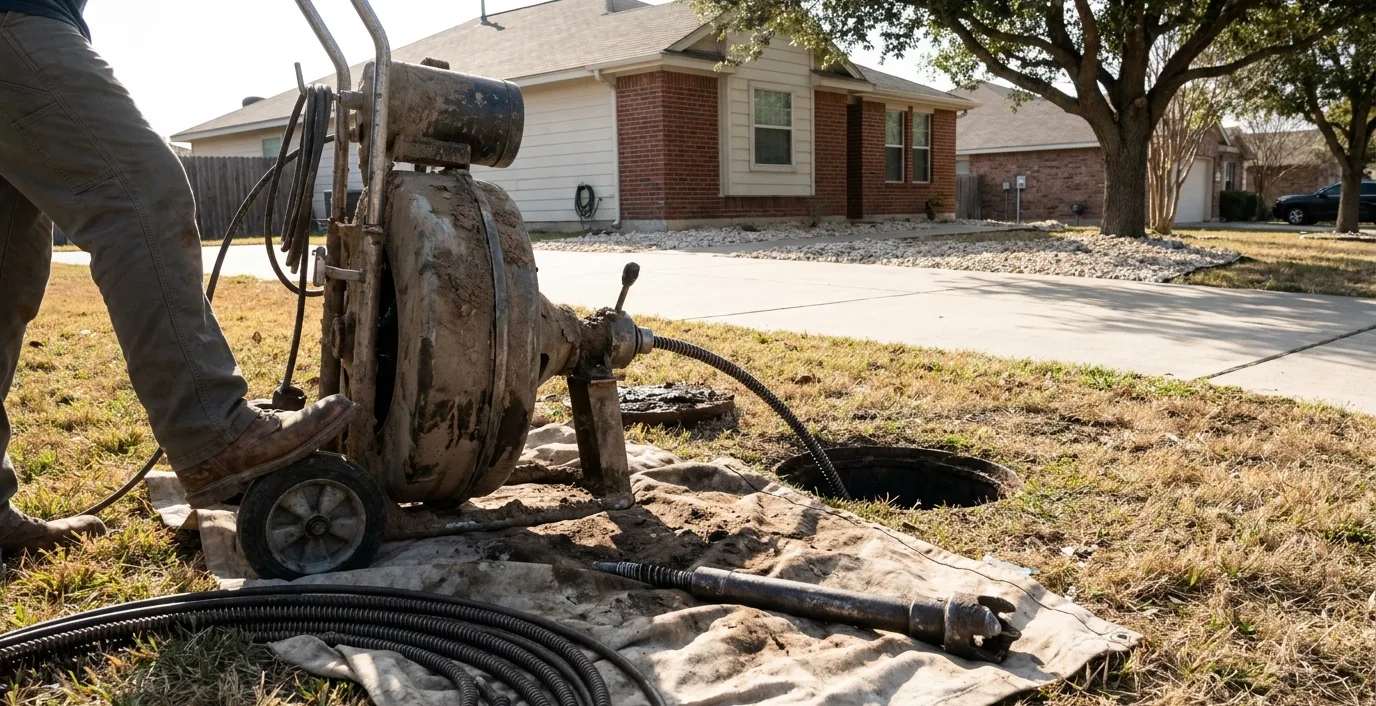
How to tell it is the main and not a fixture
The tell is not severity, it is how many places are involved and where the water shows up. A branch blockage affects what is above it. A main line blockage affects everything, and it announces itself at the lowest opening in the building.
- Flushing a toilet makes water rise in a shower or a tub — the flush volume has nowhere to go and takes the nearest low exit.
- The washing machine draining floods a floor drain — a washer discharges faster than anything else in the house.
- Toilets in different bathrooms bubble when either is used.
- Waste water is surfacing in the yard along the line, or the grass over the pipe is suddenly greener and softer than the rest.
- Every fixture in the house has gone slow within days of each other.
What blocks a lateral in Hays County
The ground under most of this area is expansive clay. It takes on water in the wet months and gives it up through the summer, and the surface moves with it. A sewer lateral buried in that soil does not move as one piece — it moves at the joints.
Roots
Live oak, hackberry, pecan and photinia all send fine roots toward an opened joint, because a leaking sewer is the most reliable water in a dry Texas August. The mat then catches everything that passes.
Offset and separated joints
Clay movement pulls a joint out of alignment and leaves a lip across the flow. Solids catch on the lip. It is the most common structural fault we film here.
Bellies
A section that has settled and lost its fall, so waste stands in it instead of running. Common where a lateral crosses ground that was backfilled when the subdivision went in.
Grease and scale
Decades of kitchen waste narrowing the bore, with hard water mineral giving it a surface to hold onto.
Things that should never have been flushed
Wipes above all. They do not break down, they catch on any irregularity, and they rope together into something remarkably solid.
Collapse
Old clay tile and unlined cast iron eventually fail outright. The camera distinguishes this from a blockage in about a minute, and it changes the conversation entirely.
Clearing it, and knowing whether it will stay clear
First the line is opened, through the exterior cleanout wherever there is one. A sectional machine with a cutting head sized to the pipe goes the full length to the city connection, not just to the point where water starts moving again — stopping at first flow is how a line blocks again three weeks later.
Then the camera. Flow tells you the obstruction has gone; it tells you nothing about why it was there. The footage is where you find the open joint, the root entry, the belly holding water or the crack that has been feeding all of it.
With that on screen, the options are honest ones: a maintenance interval that keeps a rooted-but-sound line working for years, a jetting programme where grease is the driver, or a repair quotation where the pipe itself has failed.
Where your responsibility ends
Worth knowing before anyone quotes you anything. The lateral from the house out to the connection at the public sewer is the property owner's to maintain and repair; the public main in the street belongs to the city. A blockage in the city's main is the city's problem, and it is rare but not unheard of — the sign is several neighbouring properties struggling at once rather than just yours.
If the camera puts the fault beyond your connection, you will be told that plainly and pointed at the utility, because it is not work we should be billing you for. Confirm the exact boundary with the City of Kyle before committing to any excavation — it is a five-minute phone call that occasionally saves a great deal of money.
If the camera finds a broken pipe, what are the options?
Cleaning and repair are separate conversations, and it is worth knowing the shape of the second one before you are standing in the yard having it. Broadly there are four routes, and which ones are even available depends on what the footage shows:
Spot repair
One bad section dug up and replaced while the rest of the lateral is left alone. The least disruptive and least expensive option when the survey shows a single clear defect in an otherwise sound line.
Lining the pipe
A resin liner cured in place inside the existing pipe, forming a new pipe within the old one. Needs a host pipe that is still structurally continuous, so it suits cracks and open joints rather than a collapse.
Pipe bursting
A new pipe pulled through the old route while a head breaks the old pipe outward. Replaces the whole run with only an entry and an exit pit, which is what makes it attractive under a driveway or mature planting.
Open-cut replacement
Trenching the length of the line and laying new pipe on fresh bedding. The most disruptive, and sometimes the only honest answer — particularly where the grade itself has to be rebuilt rather than the pipe merely renewed.
Trenchless methods are not automatically the better buy: they need particular conditions, and where those are absent a straight dig can be both cheaper and a better long-term result. Get the survey first, then decide — Kyle Drain Cleaning would rather quote the right repair once than the wrong one twice. Any of these will involve permits and inspection, so check what the City of Kyle requires before work is booked rather than afterwards.
Frequently asked questions
Will you try to sell me a new sewer line?
No. Most main line calls end with the line cleared and nothing else needed. When the footage does show a failed pipe you get the recording and the options, and you are free to take both to whoever you like.
How often should a main line be cleaned?
A sound line with no root entry may go decades untouched. A line with a known root problem is often best on a planned interval — the camera footage is what sets it, not a calendar rule.
Can roots be killed off for good?
Not while the tree is alive and the joint is open. Cutting and jetting buys years; only repairing or lining the defect ends it permanently.
Do I need a camera survey as well?
For a first-time blockage that clears cleanly, not necessarily. For a repeat, before buying a house, or before anyone quotes to dig, yes.
What if the pipe turns out to be broken?
You get the footage and a plain explanation of the options. There is no obligation to have the repair done by us, and no interest in selling an excavation the pictures do not support.