
Hydro Jetting in Kyle, TX
A cable makes a hole. A jetter cleans the pipe. When a line has been narrowing for years rather than blocking overnight, that difference is the whole job.
Call (737) 385-7666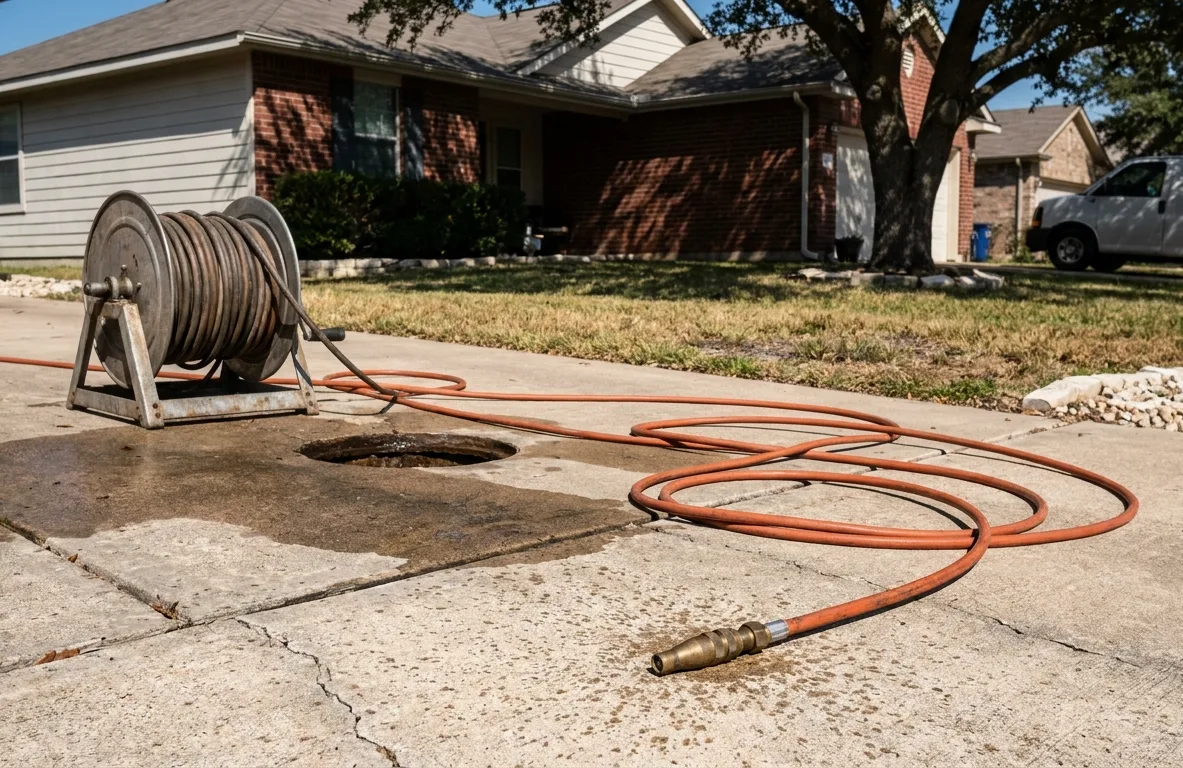
What it actually does
A jetter pushes a hose down the line with a nozzle on the end. Most of the water leaves that nozzle through rearward-facing jets, which does two things at once: the thrust drags the hose upstream against the flow, and the spray blasts the pipe wall on the way back. Debris is flushed toward the sewer rather than packed further into the line.
Nozzles are chosen for what is in the pipe. A penetrating head opens a hard plug first, a flusher moves accumulated sludge and silt, and a rotating head is what takes hardened grease and fine root hair off the wall. Doing that in the wrong order is how a jetting job ends up taking twice as long.
When jetting is the right call — and when it is not
It is a better tool than a cable for a specific set of problems and a worse one for others. Being clear about which you have is most of what you are paying for, and it is a conversation worth having on the driveway rather than halfway through the invoice.
Worth jetting
Kitchen lines coated in years of grease. Mains carrying silt and sludge. Fine root hair through joints after the cutter has been through. Scale in older pipe. Yard drains full of gravel.
Cable it instead
A single object lodged in one fixture's branch. A toy, a toothbrush, a wad of wipes. High-pressure water pushes those; a cable hooks them and brings them back.
Camera it first
Any line that has already backed up more than once, and any line old enough that nobody knows what it is made of. Jetting a collapsed or badly cracked pipe helps nothing.
Do not jet
A line the camera shows as broken, separated or crushed. That is a repair, and pressure is not going to improve it.
Root hair, and why cutting alone leaves you exposed
Roots enter a sewer lateral at a joint that has opened up — and in the shrink-swell clay across much of Hays County, joints open. Once inside, a root does not grow as a single plug. It fans into a fine mat across the bore, and that mat catches everything the house sends down it.
A cable with a cutting head shears the mass out and gets you flowing again. What it leaves is the fringe still keyed into the pipe wall, which is exactly the material that regrows fastest. Jetting after the cutter is how Kyle Drain Cleaning strips that fringe back, and the difference in how long the line then stays clear is measured in years rather than months.
How a jetting visit runs
Access and a look first
Through the cleanout wherever possible. On any line with history the camera goes down before the water does, because pressure into a broken pipe is money spent making things worse.
Open the flow
If the line is fully stopped, a cable or a penetrating nozzle makes a path so the water we are about to introduce has somewhere to go.
Work the length of the line
Pulled through in passes rather than one trip, so material is carried out to the sewer instead of being left in a heap downstream.
Camera to finish
You see the pipe wall you have paid to have cleaned, and if there is a defect behind the deposit you find out now rather than at the next backup.
Pressure and flow are not the same thing
Jetting gets sold on pressure, and pressure is only half of it. Two numbers describe any jetter, and they do different jobs:
Pressure cuts
It is what breaks a hardened deposit off the pipe wall and what gets a nozzle through a compacted plug. High pressure with very little water behind it will bore a neat hole through a blockage and leave the debris sitting exactly where it was.
Flow carries
Volume is what actually evacuates what the pressure has just cut loose, and what floats silt and grit down to the sewer instead of leaving it in a heap further along your line.
Why the balance matters
A machine that is all pressure and no flow gives you a result that looks excellent on the day and disappoints within months, because the line was opened rather than emptied. Matching both to the pipe diameter is the whole skill.
Why the nozzle is not an afterthought
The head decides where the energy goes: forward to penetrate a plug, rearward to scour the wall on the way back, or rotating to take a full circle of hardened grease. Using one head for every job is why some jetting disappoints.
None of which is a reason to jet everything. It is a reason to ask what a line actually needs before the hose comes off the reel — and on a fair number of calls the answer is that a cable will do the job and jetting would be spending your money for the sake of it.
Frequently asked questions
Does jetting use a lot of my water?
It runs off our own tank or off a hose connection, and the water goes into the sewer the same way your household waste does. If we do draw from your outside tap, we will ask first.
Will jetting damage my pipes?
Not a sound pipe — pressure and nozzle are matched to the material. The risk is in a line that is already broken, which is precisely why anything with history gets a camera before a hose.
Can it be used on old clay or cast iron?
Yes, at appropriate pressure, and in fact scaled cast iron is one of the cases where it pays best. The camera survey decides, not the age alone.
How long does jetting take?
A residential lateral is typically a couple of hours including the camera work. Heavy grease over a long run takes longer.
Is it worth it if a cable already cleared the blockage?
If the line was greased or rooted, yes — the cable restored flow, not diameter. If a single object came out and the pipe behind it is clean, no.